
100 Chart Blank
Filling in a blank 100 chart is one of the best early number activities: children write every number from 1 to 100 and discover the patterns of tens and ones for themselves. This pack gives you completely blank charts, partly filled charts at four levels of difficulty, 0–99 and 1–120 versions and puzzle pieces — ready to print, with answer keys.
- Instant download
- Print-ready PDF
- 7-day refund
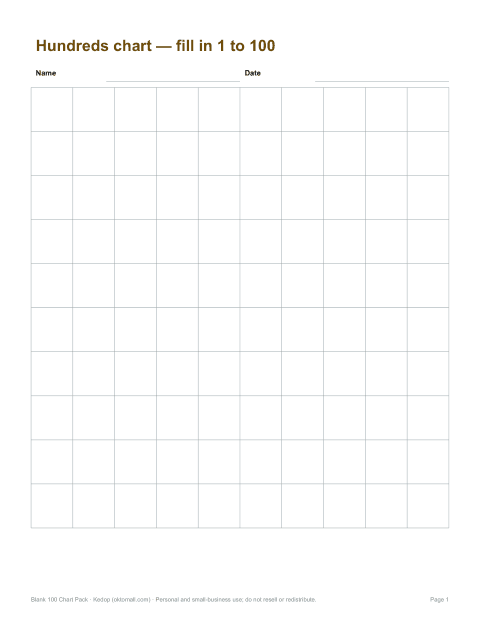
11 files · PDF
Blank 100 Chart Pack
Printable blank 100 charts, partly filled charts at four levels with answer keys, blank 0–99 and 120 charts, skip-counting sheets and a cut-apart puzzle chart.
- Blank 100 chart (PDF)
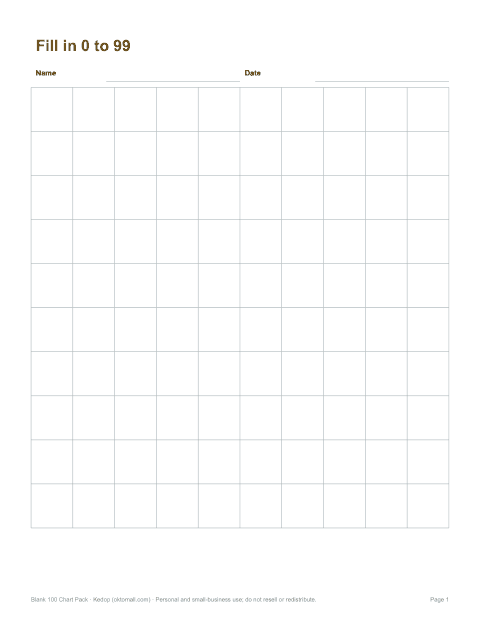
- Blank 0–99 (PDF)
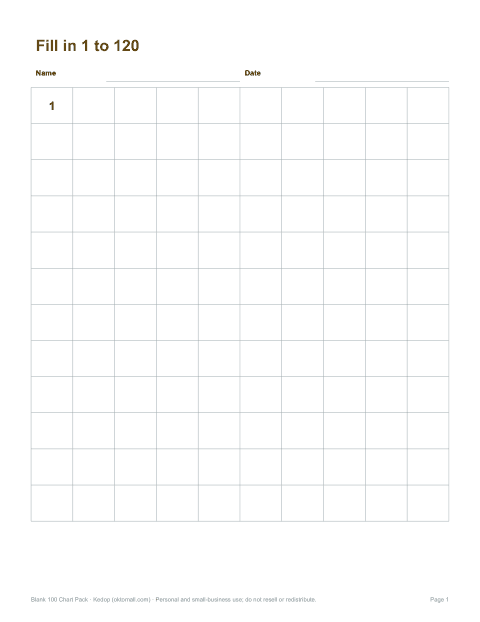
- Blank 120 chart (PDF)
- + 8 more
$5.00 USD, one-time 11 files · about $0.45 each
- Instant download
- 7-day refund
- Secure checkout by Stripe
7-day money-back guarantee. Full refund within 7 days of purchase, even after you download.
Free sample: Blank 100 Chart (PDF, 64 KB)
Blank 100 Chart Pack
Printable blank 100 charts, partly filled charts at four levels with answer keys, blank 0–99 and 120 charts, skip-counting sheets and a cut-apart puzzle chart.
- Blank 100 chart (PDF)
- Blank 0–99 (PDF)
- Blank 120 chart (PDF)
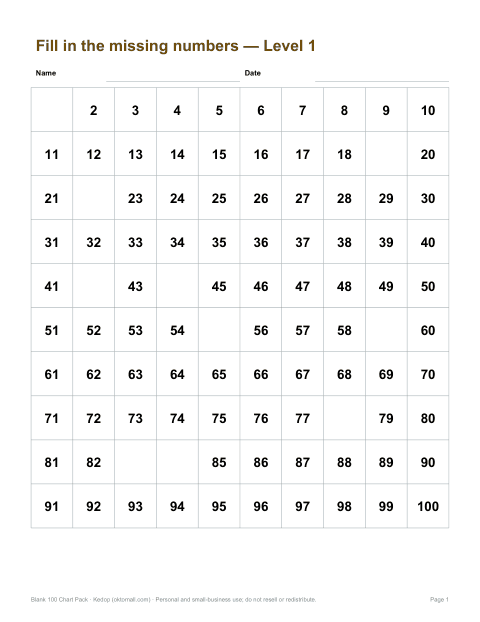
- Level 1 missing numbers (PDF)
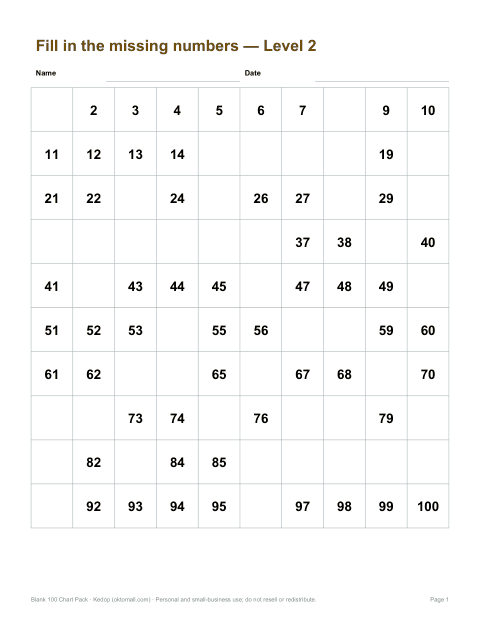
- Level 2 missing numbers (PDF)
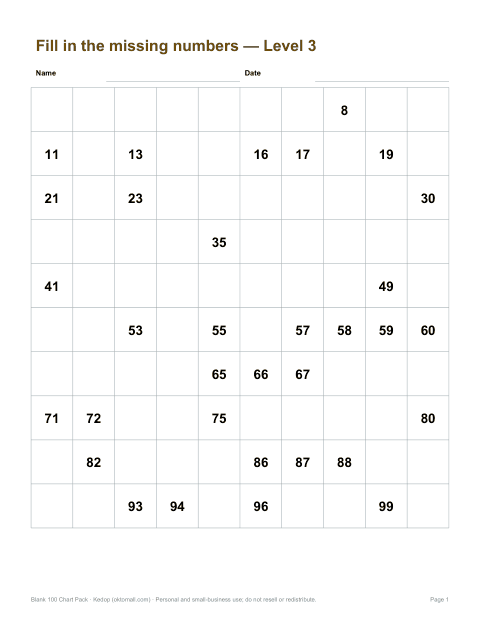
- Level 3 missing numbers (PDF)
- Level 4 tens only (PDF)
- Colour the 2s (PDF)
- Colour the 5s (PDF)
- Colour the 10s (PDF)
- Cut-apart puzzle (PDF)
Formats: PDF. Instant download after payment (link valid 72 hours, up to 5 downloads). AI-assisted: the templates were drafted with AI help and reviewed and laid out before publishing.
$5.00 USD, one-time 11 files · about $0.45 each
- Instant download
- 7-day refund
- Secure checkout by Stripe
7-day money-back guarantee. Full refund within 7 days of purchase, even after you download.
Free sample: Blank 100 Chart (PDF, 64 KB)
Full refund within 7 days — see the refund policy and license.
Free printables
Single sheets you can print right now, no sign-up. The full pack adds every sheet in one download plus the editable files.
 Printable Blank 100 Chart1 page · free PDF
 Printable Blank 0–99 Chart1 page · free PDF
 Printable Blank 120 Chart1 page · free PDF
 Printable Missing Numbers 100 Chart2 pages · free PDF
 Printable Level 2 Missing Numbers 100 Chart2 pages · free PDF
 Printable Level 3 Missing Numbers 100 Chart2 pages · free PDF
 Printable Tens-Only 100 Chart2 pages · free PDF
 Colour the 2s Printable 100 Chart1 page · free PDF
What’s in the pack
| Sheet | Use it for |
|---|---|
| Blank 100 chart | Write every number 1–100 |
| Partly filled charts (4 levels) | Fill in the missing numbers — from a few gaps to mostly blank |
| Blank 0–99 chart | Place-value focus: each row has the same tens digit |
| Blank 120 chart | Counting beyond 100 (common in first grade) |
| Skip-counting sheets | Colour multiples of 2, 5 and 10 |
| Cut-apart puzzle chart | Rebuild the chart from jigsaw pieces |
| Answer keys | Complete filled charts |
Why fill in a blank chart?
Writing numbers in order on a 10 × 10 grid makes the structure of our number system visible. Children notice that every number in a column ends with the same digit, that each row adds ten, and that after 9 comes a new row starting with a new tens digit. These discoveries lay the foundation for place value, adding and subtracting tens, and mental maths strategies later on.
Four levels of partly filled charts
| Level | Numbers shown | Skill |
|---|---|---|
| 1 | About 85% | Spot a few missing numbers |
| 2 | About 60% | Count on and back from nearby numbers |
| 3 | About 35% | Use rows and columns to work out numbers |
| 4 | Only multiples of 10 | Build the chart from the tens |
| Blank | None | Write every number |
Start at the level where a child succeeds with a little thinking, then move on.
Activities with a blank chart
- Fill in by rows — then fill another chart by columns and compare.
- Race to 100 — roll a die and fill in that many numbers; first to 100 wins.
- Pattern hunt — colour every number ending in 5; what shape appears?
- Secret picture — colour given numbers to reveal a shape or letter.
- Mystery number — “I am 10 more than 43 and 1 less than 54.”
- Puzzle rebuild — cut a filled chart into pieces and put it back together.
Worked example: finding a missing number
A child sees a gap below 34 and above 54. Moving down one row adds 10, so the missing number is 34 + 10 = 44 — and checking upwards, 54 − 10 = 44 too. If the gap is between 67 and 69 on the same row, it is 68. Encouraging children to explain how they know, using “ten more” and “one more”, turns the chart into a reasoning activity rather than just copying.
1–100, 0–99 or 1–120?
The classic 1–100 chart ends each row with a multiple of ten. The 0–99 chart puts every number with the same tens digit on one row (20 to 29 together), which many teachers prefer for place value. The 1–120 chart continues past 100, matching curricula where children count to 120 in first grade, and shows that the pattern carries on beyond 100.
Tips for teachers and parents
- Laminate a chart and use dry-wipe pens for daily practice.
- Keep a large filled chart on the wall for reference.
- Short, frequent sessions work best — ten minutes is plenty.
- Ask children to explain patterns in their own words.
- Mix blank charts with games so it doesn’t become a chore.
Formats and printing
All sheets are PDFs sized for US Letter and A4 with clear, generous squares for young writers. Answer keys are included for the partly filled charts.
AI-assisted content
Sheets were generated with AI assistance using scripted number layouts and checked before publishing.
Frequently asked questions
What is a blank 100 chart?
A 10 × 10 grid with empty squares for children to write the numbers 1–100.
What age is a blank hundreds chart for?
Mostly ages 5–8, from kindergarten to about second grade.
What is the difference between a 100 chart and a 0–99 chart?
The 0–99 chart keeps numbers with the same tens digit in one row.
Are answer keys included?
Yes, for the partly filled charts.
Can I laminate the charts?
Yes — laminated charts work well with dry-wipe pens.
Is this a subscription?
No, it is a one-time download.